Nearshoring and Infrastructure Shape Guatemala’s Next Investment Agenda
Nearshoring, infrastructure, talent and competitiveness were at the center of Guatemala Development Forum 2026 and its investment agenda.

Nearshoring is creating new opportunities for Guatemala to attract investment, but turning the country’s macroeconomic stability, strategic location and proximity to the United States into higher-value projects will depend on addressing gaps in infrastructure, talent development and competitiveness.
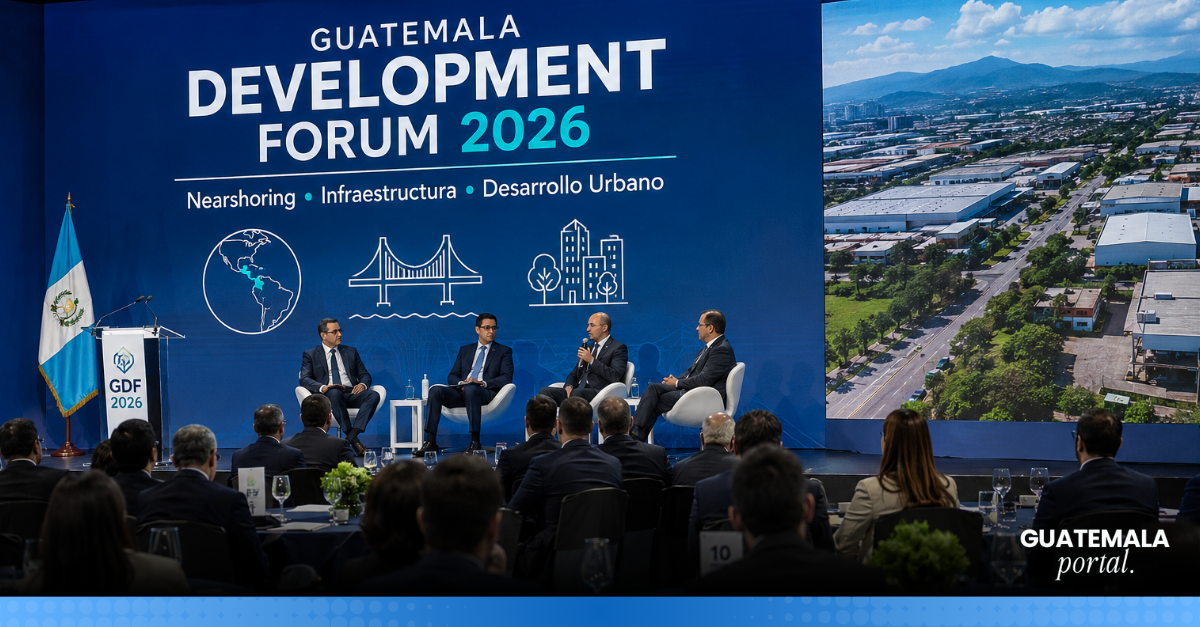
These challenges were at the center of the Guatemala Development Forum 2026, held on September 23, which brought together public-sector representatives, investors, business leaders and institutional partners to discuss the conditions needed to support the country’s next stage of economic growth.
Guatemala’s investment agenda focuses on competitiveness
The forum examined how Guatemala can translate its existing advantages into greater foreign direct investment, productive diversification, infrastructure development and competitiveness.
The agenda focused on four main areas: investment and competitiveness; infrastructure and connectivity; urban and industrial development; and collaboration and execution mechanisms.
Discussions also addressed nearshoring, free trade zones, logistics, energy and urban development, with an emphasis on public-private cooperation and long-term planning to turn priorities into projects.
Nearshoring: where should Guatemala compete?

One of the main discussions took place during the panel “Taking Advantage of Change: Nearshoring, Free Trade Zones and High-Value Growth.” The session brought together Christian Mayorga, president of the Zona Libre de Industria y Comercio (Zolic); Claudia Pellerano, president of the Association of Free Zones of Ibero-America (AZFA) from the Dominican Republic; and Alejandro Guillén, general manager of Synergy Industrial Park. The conversation was moderated by Juan Esteban Sánchez, executive director of Invest Guatemala.
The panelists discussed which sectors Guatemala could prioritize to attract investment. Their assessment was that the country does not necessarily need to compete for investment across every industry, but rather identify areas where it already has capabilities and can integrate more quickly into international value chains.
Among the sectors mentioned were specialized manufacturing, appliance assembly and automotive parts.
Guillén highlighted the potential of the automotive parts industry, suggesting that Guatemala could connect with the production chain Mexico has developed over several decades. Specific components mentioned included seat belts, airbags, seats and dashboards.
Pellerano offered a broader view of the opportunities, arguing that the strategy should not restrict the number of potential sectors too narrowly. She pointed to activities that could build on capabilities already present in the country, including more value-added agribusiness, electrical and electronic industries, automotive parts and manufacturing shared with other countries.
Talent remains a challenge for industrial investment
Human capital was identified as another important factor for companies considering Guatemala as an investment destination.
Pellerano discussed the experience of the Dominican Republic, where short- and long-term strategies have been developed to respond to companies’ workforce requirements. One approach involves connecting industrial parks with universities, technical institutes and education authorities to create courses and develop specific skills according to the needs of each region.
The discussion highlighted that companies evaluating new operations cannot always wait for the results of education reforms that may take several years.
As a result, the panel addressed short and modular training programs designed jointly with the productive sector as an alternative to quickly improve employability and respond to specific industry requirements.
Infrastructure and consistent information influence investment decisions
The forum also examined why some companies ultimately choose Guatemala while others do not, despite the country’s existing advantages.
Guillén said international investors have responded positively to Guatemala’s macroeconomic and demographic conditions, as well as to infrastructure developed within industrial parks.
However, he identified inconsistency in the information provided by different institutions as one of the challenges facing investors. According to his remarks, receiving different figures on the same issue can create concerns among companies and affect confidence in the investment process.
Port infrastructure was also identified as an area requiring attention. According to figures presented during the panel, approximately 70% of imports enter through the Pacific, while around 70% of exports leave through the Atlantic, increasing the importance of improving both port systems.
Industrial projects demonstrate investment opportunities
The discussion also highlighted examples of investments that moved forward following extended institutional support.
Guillén cited the recent opening of a 15,000-square-meter distribution center for Mabe at Synergy Industrial Park. He also mentioned Supertex, a company that manufactures for international brands including Adidas, Patagonia and North Face.
Supertex is expected to operate a 10,000-square-meter plant with a projection of 1,000 direct jobs, following a three-year negotiation involving different institutions.
Mayorga also cited Yazaki, which already operates an automotive parts plant in Guatemala and has another facility planned to begin operations next year, with the capacity to generate approximately 4,000 jobs.
Banguat: macroeconomic stability is necessary, but not enough
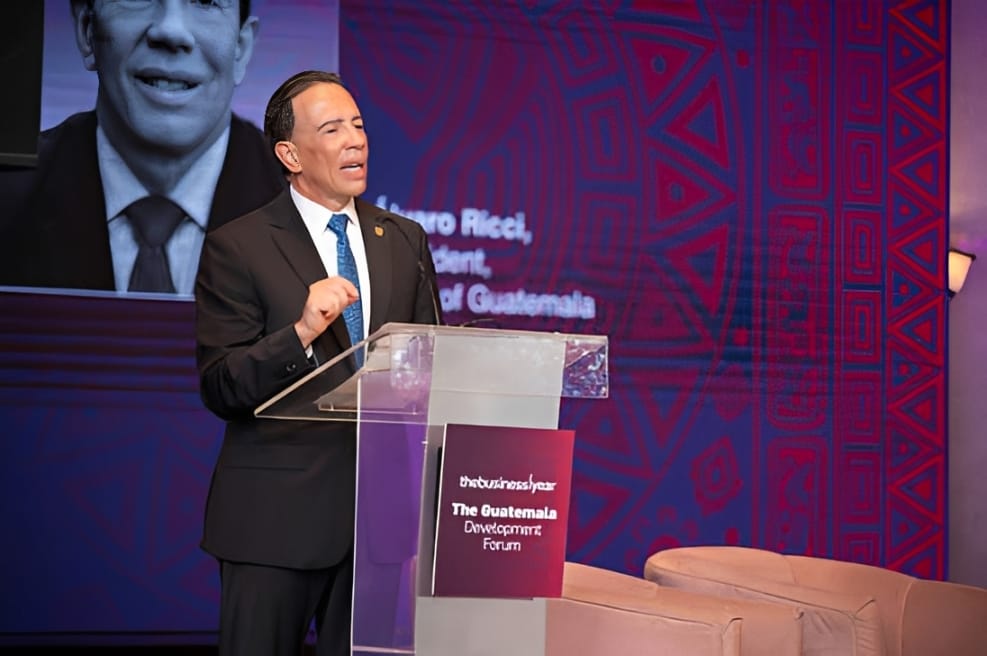
During the forum’s opening, Álvaro González Ricci, president of the Bank of Guatemala (Banguat), placed the investment discussion within the country’s broader macroeconomic context.
He highlighted Guatemala’s recognized economic stability and said estimates point to 4.3% economic growth in 2026 and 4% in 2027. He also noted that year-on-year inflation stood at 3.37% in August, within the central bank’s established target range.
At the same time, González Ricci emphasized that stability alone cannot accelerate the country’s development.
“Macroeconomic stability is indispensable, but it is not enough for what the country needs.”
According to González Ricci, taking advantage of nearshoring opportunities requires infrastructure, regional connectivity, reliable and competitive energy, investor certainty, human capital and efficient logistics.
He also pointed to better roads, ports, airports and energy networks as factors that could help reduce costs and enable Guatemala to participate in higher-value activities.
Foreign direct investment remains part of the challenge
González Ricci also compared Guatemala’s foreign direct investment levels with those of other countries in the region.
According to figures he presented during the forum, Guatemala receives around US$2.1 billion in foreign direct investment, while economies such as the Dominican Republic and Costa Rica are between US$4.5 billion and US$5.5 billion.
The comparison formed part of the broader discussion about how Guatemala can increase its ability to attract investment and move toward higher-value productive activities.
The agenda extends beyond nearshoring
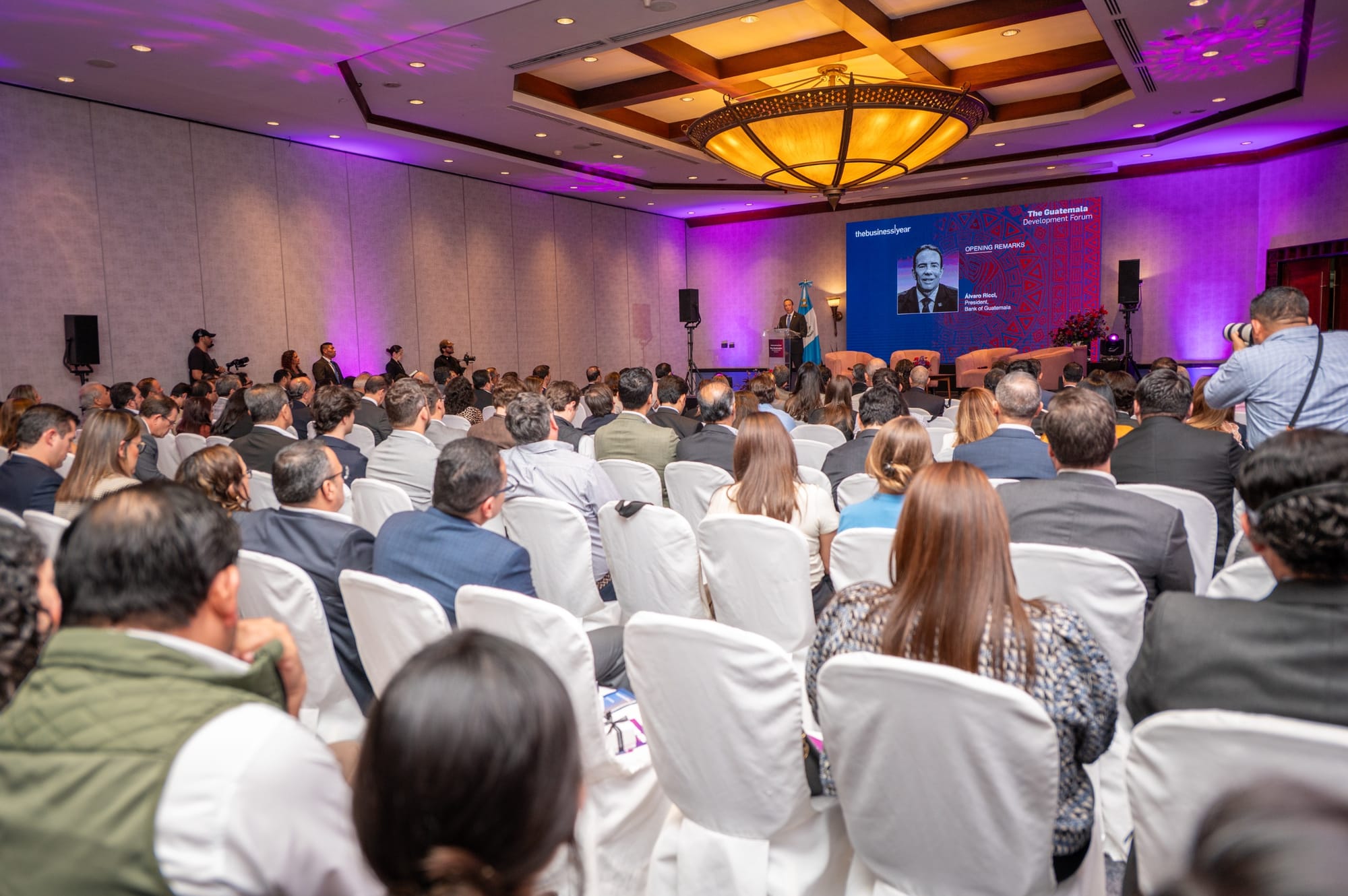
The challenges discussed at the forum were also reflected in “The Business Year: Guatemala 2026,” whose first edition focused on the country was launched during the event.
The 208-page report describes Guatemala as entering a new stage of economic development driven by macroeconomic stability, infrastructure investment, production relocation and productive diversification.
It examines opportunities associated with the country’s strategic location, preferential access to the U.S. market, manufacturing expansion, infrastructure, the digital economy, renewable energy, agribusiness and tourism.
At the same time, the publication identifies challenges including improving productivity, developing human capital and enabling Guatemala to occupy a higher-value position within regional and global production chains.
Public-private collaboration as part of the investment agenda
The Guatemala Development Forum also included discussions on closing infrastructure gaps in logistics, energy and regional connectivity, as well as on how urban development can shape the country’s economy.
The event featured the participation of Marco Antonio Villeda, Minister of the Interior, and Harris Whitbeck, director of the Guatemalan Institute of Tourism (Inguat), along with investors and executives from different companies.
Across the different sessions, the forum examined how Guatemala can translate its geographic and macroeconomic advantages into investment opportunities. The discussions emphasized that capturing higher-value projects through nearshoring will depend on combining those advantages with infrastructure, talent, reliable information, logistics and a clear strategy for the sectors the country seeks to develop.