Prosegur Cash Highlights the Continued Importance of Cash in Guatemala
Cash remains central to payments in Guatemala, with recent data showing how digitalization and cash continue to coexist across the economy.
Prosegur Cash highlights the continued relevance of cash in Guatemala as digital transformation changes how people make payments and manage their money. Recent data shows that the expansion of digital alternatives has not necessarily displaced banknotes and coins, which continue to play a central role in households' everyday transactions.
Cash remains the leading payment method
According to the 2025 National Household Financial Inclusion Survey (ENIFH), prepared by Guatemala's National Statistics Institute (INE), cash remains the primary payment method regardless of the purchase amount, being used by more than 80% of the general population, although its use varies depending on the value of the transaction.
For purchases below Q200, 93.8% of the population uses cash, while for purchases above Q200, the proportion reaches 88.6%.
These figures show that the adoption of digital payment alternatives has taken place alongside continued reliance on physical money for everyday transactions.
Money in circulation continues to grow
Monetary indicators also reflect the demand for cash within the Guatemalan economy.
According to the Bank of Guatemala, currency in circulation reached Q102,723.6 million in July 2026, compared with Q92,751.9 million in July 2025. This represents an approximate 10.8% increase over one year.
The figure includes banknotes and coins in circulation and serves as an indicator of the economy's demand for liquidity.
Informality and access help explain cash usage
Guatemala's labor market provides additional context for the continued importance of cash. The latest results published by the INE show that the informality rate stood at 66%, meaning a significant share of the employed population continues to carry out its activities outside the formal sector.
Cash also plays an important role in the flow of family remittances.
The 2025 ENIFH reports that 71.7% of households receiving remittances do so through cash withdrawals at a bank branch, while 53.7% use cash withdrawals through a banking agent.
The main destination for these resources is the payment of goods and services, reported by 48.7% of households.
Cash and digital payments can coexist
For Prosegur Cash, the data suggests that the discussion should not be framed as a replacement of cash by digital payment methods. Instead, it points toward an ecosystem in which both forms of payment coexist and fulfill complementary functions for people.
“The reality of Guatemala demonstrates that the evolution toward a more digital economy does not mean that cash is losing relevance. On the contrary, the data shows that it continues to be a fundamental part of transactions for households, businesses, and other economic actors. The real challenge is to ensure that cash management becomes increasingly secure, efficient, and traceable,” explained Antonio Robledo, Commercial Manager of Prosegur Cash in Guatemala.
Logistics remain essential to cash availability
Maintaining access to cash across Guatemala also requires significant operational and logistical capacity, particularly given the country's geography.
Currently, Prosegur Cash's fleet of armored vehicles travels more than 360,000 kilometers per month nationwide, supporting the continuous and secure supply of cash to more than 1,100 ATMs and commercial establishments.
This operational capacity helps ensure that different regions maintain access to funds, including under challenging weather or social conditions.
The continued importance of cash is therefore connected to several factors, including financial inclusion, economic informality, the resilience of the payment system, access in rural areas, and the confidence of different segments of Guatemala's population.
Digitalization is also changing cash management
The coexistence of physical and digital payment methods creates new challenges for companies. For retailers and financial institutions, efficient cash management requires processes that can reduce risks, optimize operations, and ensure that money is available where consumers need it.
In this context, digitalization does not necessarily eliminate cash. It can also transform how physical money is managed.
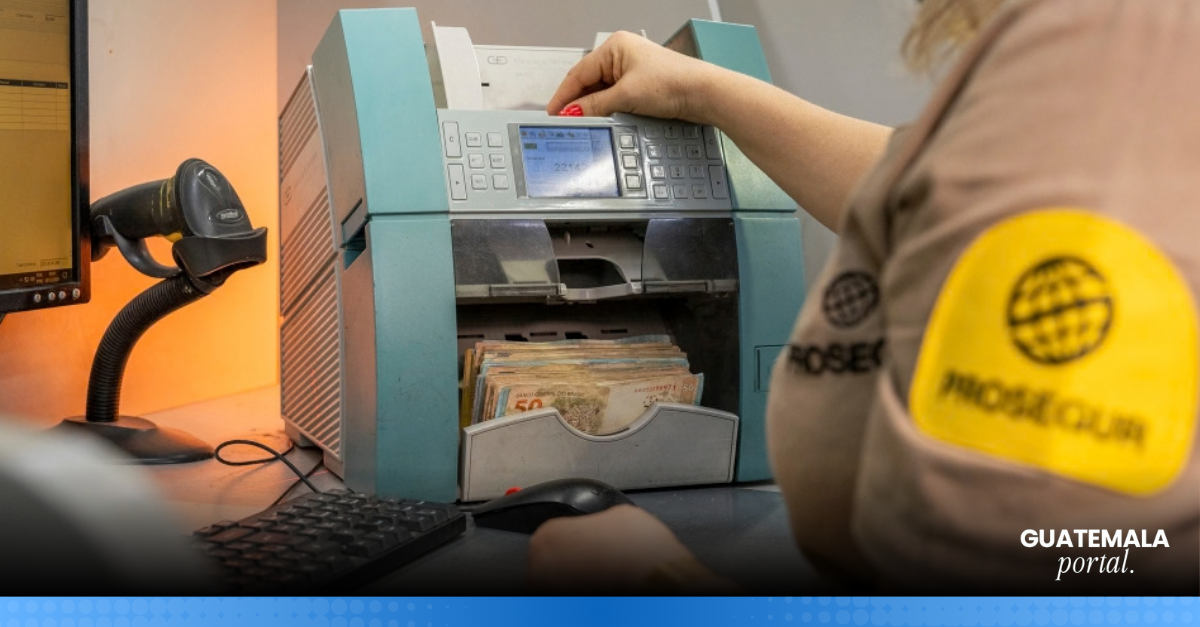
Cash management solutions can automate processes, improve resource traceability, and reduce exposure associated with manual cash handling, connecting physical operations with new technological tools.
“We are facing an economy that is moving toward increasingly hybrid payment models. People are adopting new digital alternatives, but they continue to use cash when it better responds to their needs. For companies, this means they must be prepared to manage both ecosystems safely and efficiently,” added Robledo.
Guatemala moves toward a hybrid payments ecosystem
The future of payments in Guatemala points toward the coexistence of cash, cards, transfers, and other digital solutions.
Rather than competing directly with one another, these payment methods respond to different needs and consumption moments. At the same time, the secure and efficient management of cash continues to represent an important component of the country's economic activity.