Guatemala Secures First Forest Carbon Payment Under World Bank Program
Guatemala receives its first results-based carbon payment from the World Bank after reducing 4.84 million tons of CO₂, with Q175.4 million allocated to forest conservation projects nationwide.

Guatemala has secured its first million-dollar payment from the Banco Mundial under a results-based carbon finance mechanism, marking a milestone in the country’s efforts to reduce emissions and protect its forests through large-scale, community-based conservation programs.
First carbon payment linked to emissions reduction
The Government of Guatemala confirmed at the end of December 2025 that the country received its first payment from the Forest Carbon Partnership Facility (FCPF) of the World Bank. The transfer corresponds to the verified reduction of 4.84 million tons of carbon dioxide equivalent (tCO₂e).
The payment had been announced by the World Bank in November and represents Guatemala’s first compensation under this international carbon finance framework.
Q175.4 million allocated to forest-related projects
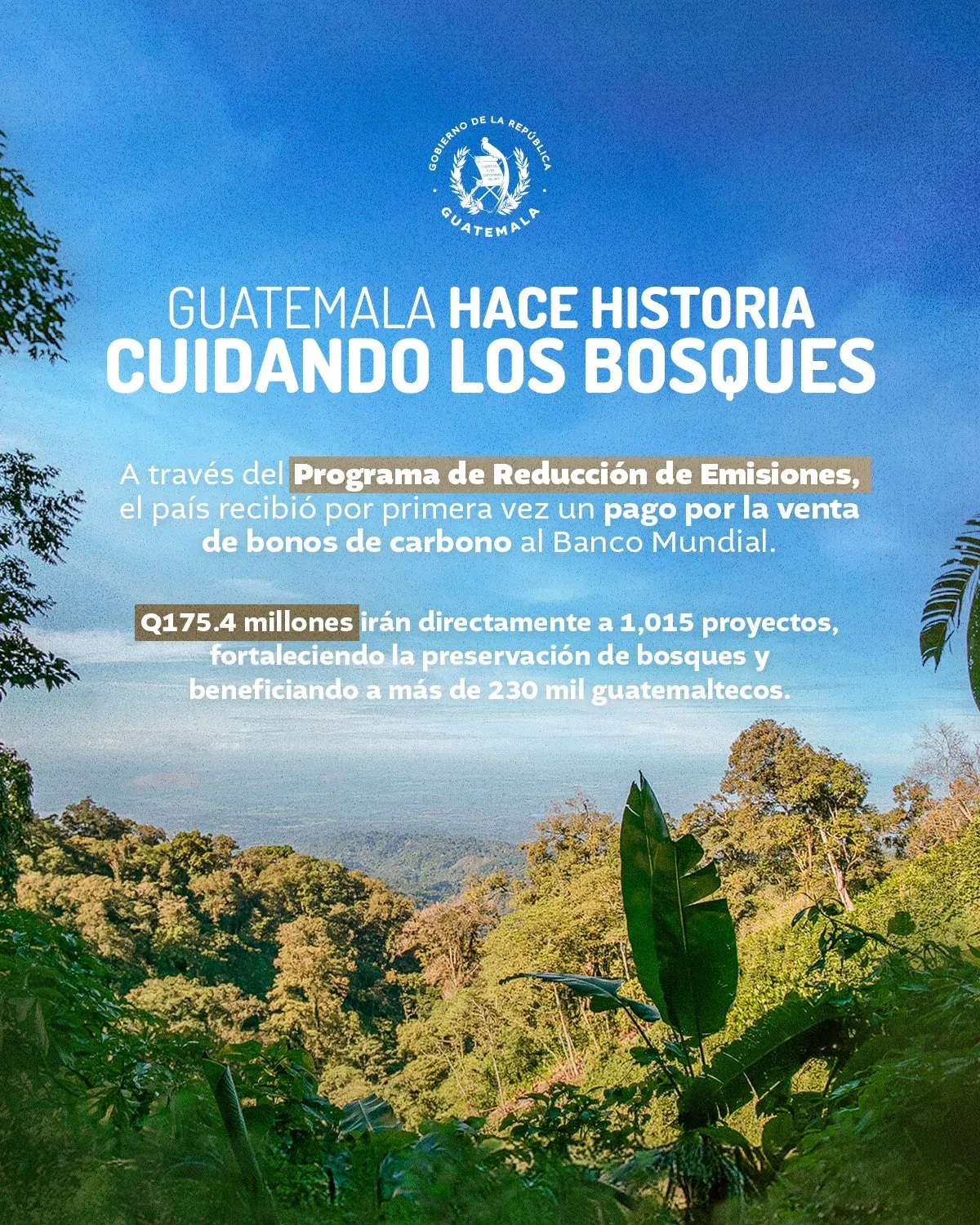
According to official government information, Guatemala received Q175.4 million, which will be distributed across 1,015 projects aimed at strengthening forest conservation efforts. The initiative is expected to benefit 230 Guatemalans, supporting livelihoods linked to sustainable land use and forest protection.
The World Bank explained that the results stem from Guatemala’s jurisdictional forest carbon program, which covers 92% of the national territory, making it one of the most extensive programs of its kind in the region.
Inclusive benefit-sharing and focus on vulnerable groups
Because the payment is results-based, the funds will be distributed through an inclusive Benefit Sharing Plan, designed to support stakeholders involved in forest protection, reforestation, restoration, and agroforestry activities.
The World Bank emphasized that the plan prioritizes initiatives with Indigenous peoples, women, and vulnerable groups, recognizing their critical role in managing forests, water resources, and biodiversity. Small-scale producers and their families are among the main beneficiaries of the program.
A long-term forest conservation strategy
The World Bank highlighted that Guatemala’s forest program builds on more than 25 years of national investment in natural resource protection. It relies on co-management models between local communities and the National Council of Protected Areas (CONAP) and incorporates community-based REDD+ projects.
Beyond emissions reductions, the program delivers social and environmental co-benefits. According to the World Bank, its activities have already generated more than 50,000 jobs, with the potential to create additional employment as benefit distribution investments are implemented.
La ministra del MAGA, María Fernanda Rivera, destacó que Guatemala logró un hito histórico al cerrar, tras dos décadas de negociaciones, el pago del Programa de Reducción de Emisiones (PRE) en diciembre de 2025, por la venta de 4.8 millones de toneladas de CO₂ al Banco Mundial. pic.twitter.com/mJfD27fP2d
— 📻 Radio TGWTV (@RadioTGWTV) January 7, 2026
The ERPA agreement and emissions reduction targets
In October 2021, Guatemala and the World Bank signed a US$52.5 million agreement aimed at reducing carbon emissions and conserving forests. As part of this deal, the country committed to an Emission Reductions Payment Agreement (ERPA) to cut 10.5 million tons of carbon emissions by 2025.
The initiative was driven in part by long-term deforestation trends. In 2021, data showed that approximately 35% of Guatemala’s territory remained forested, compared to nearly 50% in 1950.
Drivers of deforestation in Guatemala
The World Bank has identified multiple factors behind forest loss in Guatemala. These include the expansion of agriculture, cattle ranching, and urban settlements, as well as forest fires, pests, diseases, and illegal logging.
Underlying socioeconomic and cultural conditions, along with institutional and productive weaknesses, continue to pose challenges to forest conservation, reinforcing the need for integrated, long-term solutions such as the FCPF-backed program.